
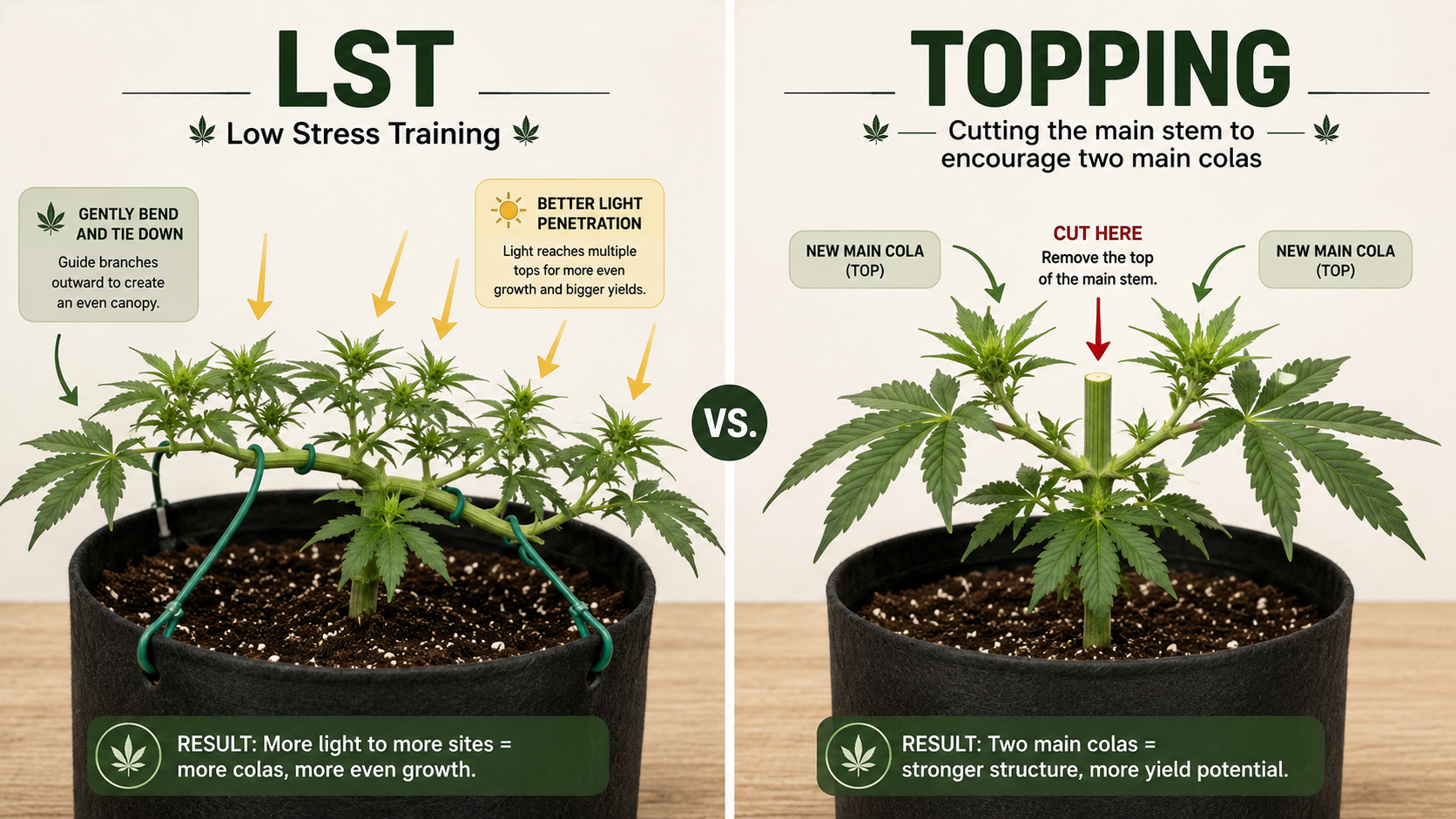
If you've spent any time reading about cannabis cultivation, you've probably come across two popular training techniques: Low Stress Training (LST) and topping.
Both are commonly used to help shape plants, encourage more even growth, and make better use of available light.
But if you're new to growing, it's easy to wonder:
Which one is better?
The honest answer is that neither technique is universally better than the other. They simply achieve similar goals in different ways.
Understanding how they differ can help you decide which approach fits your grow.
What Is Low Stress Training (LST)?
Low Stress Training, often called LST, involves gently bending and securing branches to encourage the plant to grow in a more even shape.
Instead of removing parts of the plant, you're simply guiding its growth over time.
Many growers like LST because it's a gradual process that allows them to shape their plants without making major cuts.
What Is Topping?
Topping involves removing the growing tip of the main stem.
This encourages the plant to redirect its energy into multiple new growth points rather than continuing to grow from a single main stem.
While it can help create a bushier plant, topping is considered a higher-stress technique because the plant needs time to recover after being cut.
Benefits of LST
Many growers choose LST because it:
-
Helps create a more even canopy
-
Improves light distribution
-
Doesn't involve cutting the plant
-
Can be adjusted gradually as the plant grows
-
Is often beginner-friendly
LST also gives growers flexibility since training can continue throughout much of the vegetative stage.
Benefits of Topping
Topping is popular because it can:
-
Encourage bushier growth
-
Create multiple main branches
-
Help manage plant height
-
Pair well with other training techniques
Many experienced growers include topping as part of their overall training strategy.
Can You Use Both?
Absolutely.
In fact, many growers combine topping and LST during the vegetative stage.
For example, a grower might top the plant early and then use LST afterward to guide the new branches into an even canopy.
These techniques aren't competitors—they can work together.
Which One Is Better for Beginners?
If you're growing your first plant, LST is often an approachable place to start.
Because you're bending rather than cutting, many new growers feel more comfortable learning how their plants respond.
It also gives you the opportunity to make gradual adjustments instead of committing to a single cut.
As your confidence grows, you may decide to experiment with topping on future grows.
Every Plant Is Different
One thing that's important to remember is that every grow is unique.
Different genetics, growing environments, and personal preferences all influence how a plant responds to training.
Some growers love topping.
Others prefer LST.
Many use both.
The best way to discover what works for you is to experiment, observe your plants, and learn from each grow.
Keep Track of What You Try
Plant training is one of those things that's easy to forget between grows.
When did you top the plant?
How did it respond?
Did one training method produce better results than another?
Keeping notes and taking progress photos makes it much easier to compare techniques over time.
After a few grows, you'll have your own experience to guide future decisions.
Final Thoughts
So, which is better: LST or topping?
There isn't a single right answer.
If you're looking for a gentle, flexible way to shape your plants, LST is an excellent option.
If you're comfortable making a cut and want to encourage bushier growth, topping may be worth exploring.
Many growers eventually find that using both techniques together gives them the best results.
No matter which method you choose, remember that training isn't about creating the "perfect" plant. It's about learning how your plants grow, making thoughtful adjustments, and improving a little with every cycle.